
SEO & AI visibility
How UltimateSEO measures SEO and GEO
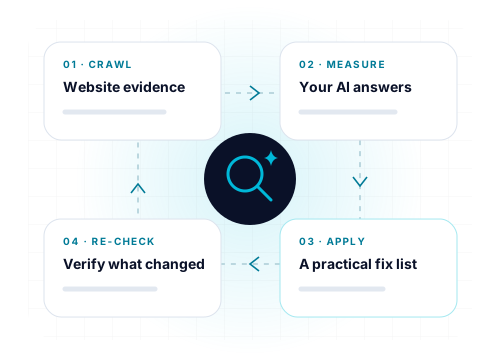
UltimateSEO inspects only what it can show you: the crawl records every checked URL, the report states its coverage and limits, and each finding carries the evidence, the framework control and the change class. Anything that cannot be verified from the available data stays open as UNKNOWN instead of being presented as a pass.
Coverage, evidence and scoring explained before you rely on a result.
SEO crawl coverage
Each run follows same-domain links and sitemap URLs, respects the supplied robots rules and inspects up to 10 pages. Requests have size and timeout limits. Redirect destinations are checked before retrieval. Crawl coverage lists the pages inspected, exclusions and whether the page limit was reached.
Checks include HTTP errors, titles, descriptions, canonical annotations, headings, mobile viewport, image alt attributes, JSON-LD syntax and duplicate content signals. Only links whose destinations were crawled can be labelled broken by this crawl. JavaScript-rendered content needs an additional rendered inspection.
Crawl health
Crawl health is the percentage of retrieved pages without critical, high or medium findings in this rule set. It is labelled crawl-health-v2. Informational findings do not reduce the score. This score describes this crawl; it is not a Google ranking score. A sitemap lists URLs and does not prove that Google indexed them.
GEO observations
An observation records the provider, surface, prompt, answer, model when available, run number and collection time. Imported observations are customer-supplied; their original measurement date may be unknown. Automatic API observations are obtained using the customer's saved API connection. These surfaces are grouped separately.
Mention rate measures whether the recorded text names the brand. Explicit recommendation rules inspect nearby wording; ambiguous mentions remain unknown. Brand-source rate describes domain matches among supplied or provider-returned source URLs. Links are not independently verified, and citation presence does not prove a claim. Description accuracy remains unknown without a verified factual assessment.
Missing results and comparisons
Unavailable evidence is displayed as Not measured. An incomplete provider run retains successful answers and shows its failures. Re-crawl comparisons classify resolved, remaining and new findings; an uninspected page is not counted as fixed.
Google Search AI features
Google’s current guidance builds AI Overviews and AI Mode on Search foundations. Check indexing and snippet eligibility together with the effective Search Console generative inclusion setting. Actual account settings and appearances are not established by a website crawl. These Search surfaces remain separate from the Gemini application.
Source: Google Search Central: AI features and your website.
Optional context files
A llms.txt file can organise verified website context, but it is not a Google ranking requirement. Google-Extended controls Google's specified AI training and grounding uses; Googlebot remains relevant to Google Search crawling.
128 controls, with honest limits
The current v4.3 catalogue contains 128 controls. Automated page checks do not establish every control. Business truth, account settings, publication authority and contextual review require separate evidence. A partial quality score shows assessed weight and a possible range; unknown critical prerequisites do not become permission to publish.
Keep useful existing resources. Confirm a problem, consider no change, inspect affected URLs and review the candidate before applying it. A report produces findings and drafts, not an autonomous CMS deployment.
Connected search performance
In Workspace → Search performance, connect the verified property for your project. Google uses read-only OAuth; its sign-in button is available after the operator completes Google setup. Bing uses your own Webmaster API key. Credentials are encrypted at rest, and daily refresh is off until you enable it. Disconnecting removes the stored credential and stops future scheduled requests; saved reports remain historical evidence.
The import window covers 28 days ending three days ago. Google uses Pacific date boundaries, requests property totals separately and imports up to 1,000 top query/page rows. Anonymised and omitted rows mean the query table is incomplete. Bing rank/traffic statistics combine search verticals including Web and Chat; they do not isolate Copilot citations. Missing dates are not filled with zeroes. A failed refresh preserves the last successful report and its import time.
Native Google AI reporting
Google documents a Generative AI Performance report for Search. Its impressions, property, native timezone and aggregation belong to that report. UltimateSEO’s Search Console CSV and read-only Search Analytics imports handle conventional search rows; they do not automatically collect this separate native report. Missing access or insufficient data stays unmeasured.
New to the terminology? Compare SEO, GEO, AEO and AIO with a worked example.